
Estimated reading time: 9 minutes
Lesson Overview
Psalm 104:24–30 praises God for the many creatures He wisely made. Their food and life depend on His continuing care.
Passage
Psalm 104:24–30
Central truth
God wisely made and cares for His many creatures.
The children’s response
Notice one creature and something it needs, and hear that God wisely provides for His creation.
Focus to remember
God is wise. He cares for His creatures.
Read Overview and preparation before leading. Printable Resources supplies the whole teaching pictures, colouring backup, making page and optional take-home page.
Before the children arrive
- For the group: a Bible, one set of the 3 whole teaching pictures (Printable Resources, pages 1–3), and familiar large play materials.
- For your chosen activity: prepare the quantities given below. Keep one colouring page (page 4) and one large crayon per child as a backup, with extra colours to share.
- For finishing: a tray for work and adult cleaning cloths. Offer one whole take-home page (page 6) per household if wanted, or its separate PDF.
Place the pictures where everyone can see them. Keep a comfortable quiet space within the supervised group. Choose an activity you can support with the adults present, without compulsory waiting turns.
How the lesson unfolds
45-minute session
- 10 min
- Welcome and play
- 10 min
- Hear the Bible accountincluding gathering and responses
- 20 min
- Activity and conversationincluding familiar play and cleanup
- 5 min
- Remember and praythen supervised collection
Use these times as a gentle guide. Leave room for settling, looking, questions and practical care.
Welcome and play
Greet each child by name and help them settle with familiar large play materials. Sit nearby and join their conversation. You might notice a toy animal and ask, “Have you seen a bird today?” A child can answer, point or carry on playing while you talk. Let welcome be a time to feel at ease together. Give a short warning before gathering and help children return the toys to their usual place.
Hear about our wise Creator
Open your Bible at Psalm 104. Say, “A psalm is a song in the Bible. This one praises God for the world He made. Let’s hear some of its words.”
Keep the Bible open. Read this line from verse 24, then explain it. Show one whole picture at a time and pause briefly for the children’s responses.
In wisdom you have made them all
God made all these things wisely. God knows what He is doing. Look at His world: there are so many different living things!
Picture 1 · Food, water and a place to rest
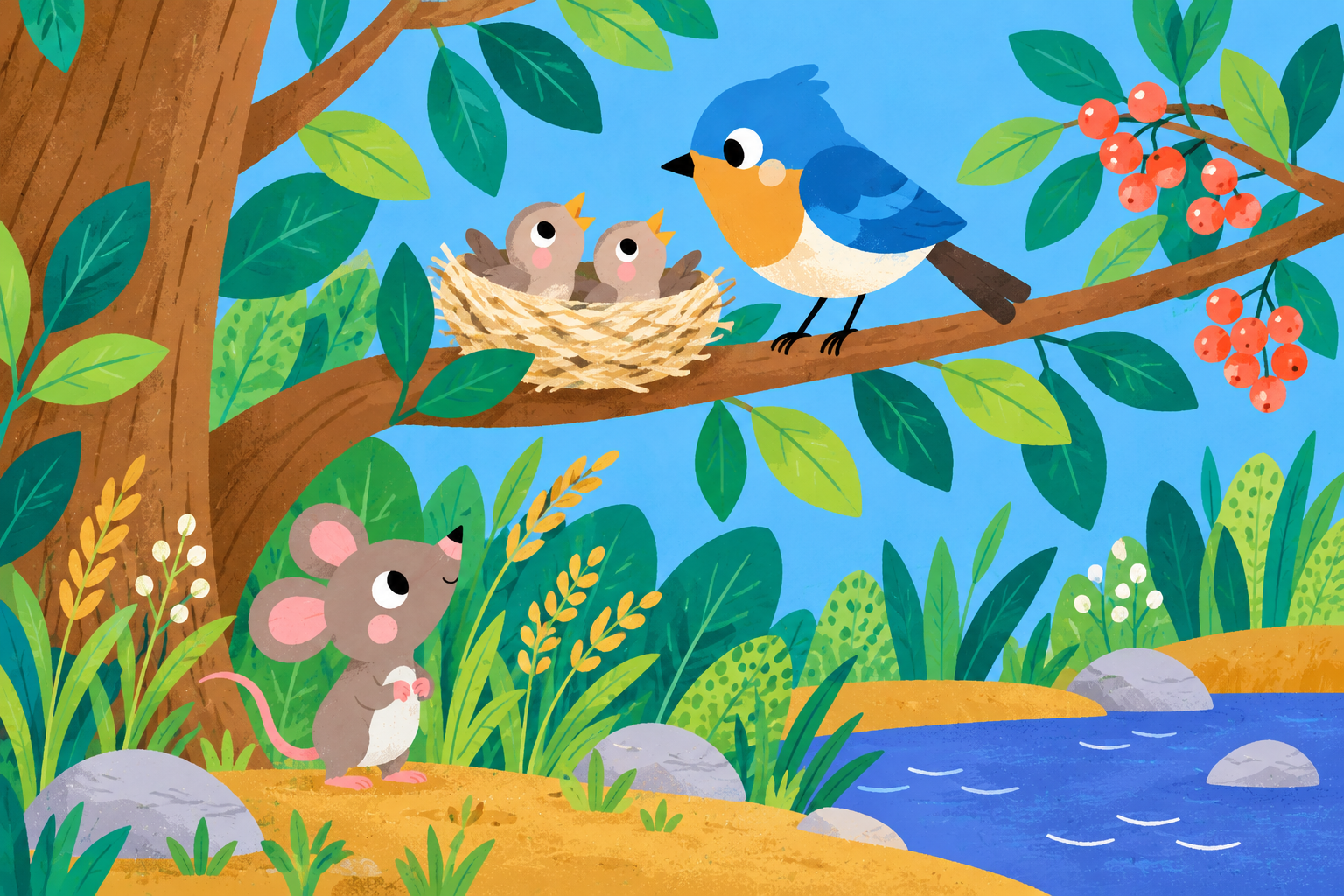
Ask “Can you find the little birds? Where are they resting?”
Look and listen for A point towards the chicks or their nest. A child may say “birds” or “nest”.
If needed Point to the nest and say, “Here they are, resting in their nest.” Then show the berries, seed grasses and water: “God made a world with food, water and places for His creatures to live.”
Picture 2 · Creatures on the land
Here are a goat, a mouse and a bird. They are different from one another. They all need food. The goat can eat growing plants, and birds find food too. The psalm tells us that creatures depend on God to give them food. God did not make them and forget about them.
Point to the goat, then the bird. Invite a gentle wing movement from each child’s place, or let them watch your movement.
Picture 3 · Creatures in the sea
The psalm also tells us about the great wide sea. There are living creatures in it, large and small. Here are some fish in the water. God made sea creatures too, and they depend on His care.
Ask “Can you find a little creature?”
Look and listen for A point to a small fish or the crab.
If needed Name one and show it: “Here is a small fish. God made small creatures as well as big ones.”
God keeps giving life to His world. The Bible also tells us that everything was made through Jesus, God’s Son. He holds His creation together. We can thank our wise God. God is wise. He cares for His creatures.
Choose an activity and remember
Choose one option for your group; the children do not need to complete all three. Join their making or play and keep the teaching pictures nearby. Children may return to familiar play when they finish, with colouring available as a backup.
Notice and help: A child may name a creature or point to its water, food or resting place. Ask, “What does this creature need?” Help with one visible example, then connect it to God’s wise care. Use children’s responses to guide your help without requiring everyone to answer.
Option 1 · Colour the creatures God cares for
Prepare: One colouring page (Printable Resources, page 4) and one large crayon per child, with extra colours to share. Keep the matching whole teaching picture visible.
Choose colours and make marks
Let children colour a small part or the whole picture in their own way. They may point or choose a colour while you steady the sheet.
Remember together
Notice the nest, food plants or water. Say, “God wisely made His creatures. They depend on His care.”
With help: Offer two colours, hold the page or look at the picture together. Finishing is optional. For more: Ask why a fish needs water or a bird needs food. Help the child move from naming the creature to recognising its dependence on God.
Give a short warning, help return crayons and put the pages in the work tray.
Option 2 · A place for God's creatures
Prepare: For each child: one two-area making page or plain sheet, one large sponge piece and one crayon. For each table: two shallow trays with small amounts of suitable washable blue and green paint, a protective cover and cleaning cloths. An adult checks paint labels and sensitivities. Offer crayons instead of paint from the start.
Choose a place
Show the land and sea pictures. Invite children to choose a colour and decide where to put broad land or water marks on their page. The two areas are starting spaces, not a test of drawing a map.
Press and lift
Demonstrate one gentle sponge press on spare paper. Let children print, repeat or change the spacing. They may use broad crayon marks instead. Keep a whole creature picture nearby rather than adding small cut-outs.
Add what a creature needs
Once the paint is dry enough, children may add their own marks for plants or a creature, or simply point to one in the teaching picture. Ask, “What might live here?” Explain one need and thank God for His wise care.
With help: Steady the page and offer one sponge or crayon. A child may choose a colour while an adult makes a mark where they point. For more: Invite a child to add food or a resting place and tell you why a creature needs it.
Children put sponges in a tray. An adult collects paint, wipes surfaces and helps wash hands; lay wet pages flat to dry.
Option 3 · Where does it live?
Prepare: For each small group: one flat blue cloth or paper mat, one green or brown mat, and three large toys such as a fish, a goat and a bird. All toys must suit the youngest children and have no small detachable pieces. If toys are unavailable, use the whole land and sea teaching pictures.
Make two places
Lay the mats on a low table. Name water and land. Invite a child to choose a creature and look at it with you.
Choose where it belongs
Ask, “Where could the fish live?” Let children place, point or change their choice. Help gently: “A fish needs water.” A bird can fly and rest in a tree on land; a toy need not have only one possible place.
Notice care
Choose another creature and talk about food, water or somewhere to rest. Say, “The psalm praises God. He wisely made these creatures, and He cares for them.” Let children continue arranging while you join their conversation.
With help: Offer a fish and the water mat, naming the connection as the child places or points. For more: Invite a child to explain a choice or name another thing the creature needs.
Return the toys to one tray and fold the cloths with adult help.
A quiet or no-print option
Look at one creature picture beside an adult, or notice a bird through a safe window. Name one thing it needs. Without printing, mark land and water on plain paper; crayons can replace the painting materials.
Keep the last few minutes of the activity period for tidying and helping children clean their hands. Watching, pointing, choosing and speaking in a familiar language are welcome ways to participate.
Remember and pray
Read the short Bible verse from Psalm 104:24 once more. The focus words below summarise the lesson; they are not a Bible quotation.
Show the sea and animal pictures once more. Ask, “What does this creature need?” Accept one example such as water or food and help supply an answer. Then ask, “Who wisely made these creatures?” Say the focus statement together. Read the short Bible line again if there is time; listening or saying one word is enough.
Say, “I’m going to thank God for His wise care. You may listen or join me.”
A simple prayer
God, You are wise. Thank You for making so many living creatures and caring for Your world. Help us to be thankful and gentle with what You have made. Amen.
Offer each child their work and the take-home page if wanted. Tell the collecting adult, “We heard a psalm about God’s wise care. This page has a picture, our focus and some words from the Bible to enjoy together.” Its separate PDF is in Printable Resources. Keep a familiar quiet toy or picture available and continue supervising according to your church’s collection arrangements.
The Christian Standard Bible. Copyright © 2017 by Holman Bible Publishers. Used by permission. Christian Standard Bible®, and CSB® are federally registered trademarks of Holman Bible Publishers, all rights reserved.