
Estimated reading time: 9 minutes
Lesson Overview
In Genesis 3:1–15, Adam and Eve disobey God and hide. God speaks to them and announces a promise that leads us towards His Rescuer.
Passage
Genesis 3:1–15
Central truth
People disobeyed God, but God did not abandon His purpose to rescue.
The children’s response
Hear what God said, recognise that Adam and Eve chose to disobey, and hear His promise of rescue.
Focus to remember
We need God’s rescue.
Read Overview and preparation before leading. Printable Resources supplies the whole teaching pictures, colouring backup, making page and optional take-home page.
Before the children arrive
- For the group: a Bible, one set of the 3 whole teaching pictures (Printable Resources, pages 1–3), and familiar large play materials.
- For your chosen activity: prepare the quantities given below. Keep one colouring page (page 4) and one large crayon per child as a backup, with extra colours to share.
- For finishing: a tray for work and adult cleaning cloths. Offer one whole take-home page (page 6) per household if wanted, or its separate PDF.
Place the pictures where everyone can see them. Keep a comfortable quiet space within the supervised group. Choose an activity you can support with the adults present, without compulsory waiting turns.
How the lesson unfolds
45-minute session
- 10 min
- Welcome and play
- 10 min
- Hear the Bible accountincluding gathering and responses
- 20 min
- Activity and conversationincluding familiar play and cleanup
- 5 min
- Remember and praythen supervised collection
Use these times as a gentle guide. Leave room for settling, looking, questions and practical care.
Welcome and play
Help each child settle with familiar play materials. Join them without turning the welcome into an obedience exercise. If a child recalls something God made, you can say, “Yes, God made the world. We will hear more from the Bible today.” Give a brief warning before helping everyone tidy and gather.
Hear the account and God’s promise
Open the Bible and invite the children to listen, point or look as you tell the account.
Keep your Bible open at Genesis 3. Show one picture at a time. Use a calm storytelling voice, with a short pause after a question. The words below summarise the passage; the Read aloud panel supplies the Bible quotation.
Picture 1 · God’s good garden and word
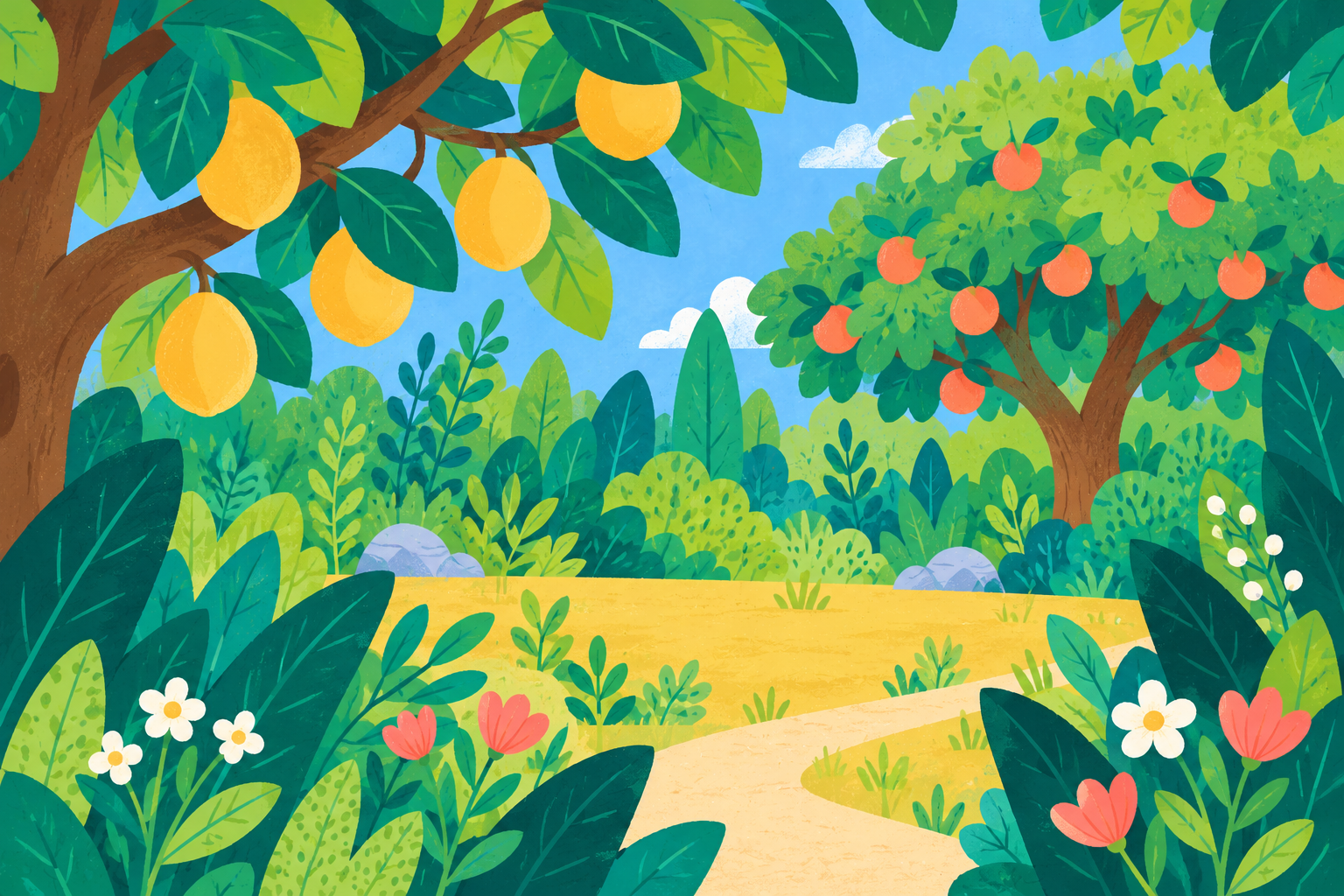
God made a good world. He made the first man and woman, Adam and Eve. He gave them a garden with good food to eat. God told them that they could eat fruit from the trees, but not from one particular tree. God’s word was good. They were to trust Him and obey Him.
Ask “What did God say about that one tree?”
Look and listen for That they must not eat its fruit.
If needed Say, “They could eat from the other trees, but not from that one.”
Picture 2 · The people disobeyed
The serpent spoke to Eve and told her something different from God’s word. Eve took fruit from the tree God had told them not to eat from. She ate it and gave some to Adam. He ate it too. They disobeyed God. That is sin: turning away from God and His good word.
Now they were afraid. They made coverings from leaves and hid among the trees. They could not hide what they had done from God. Listen to what the Bible says next.
So the LORD God called out to the man and said to him, “Where are you?”
God knew where Adam was. He called him and asked about what had happened. Adam blamed Eve, and Eve spoke about the serpent. But both Adam and Eve had disobeyed. They needed God’s rescue.
Picture 3 · God promised a Rescuer
God spoke to the serpent. He promised that someone from the woman’s family would defeat the serpent. The serpent would not win for ever. God had a purpose to rescue people.
Later in the Bible we learn about Jesus, God’s Son. He is the promised Rescuer. Jesus obeyed His Father. He died for our sins and rose again. We cannot put our sin right on our own. We need Him. We need God’s rescue.
Point to the open Bible again. Say, “The Bible tells us this good news about Jesus.” Read the short line below and explain “sinners”.
Christ Jesus came into the world to save sinners
Sinners are people who turn away from God. That includes grown-ups and children. Jesus came to save people like us.
Choose an activity and remember
Choose one option for your group; the children do not need to complete all three. Join their making or play and keep the teaching pictures nearby. Children may return to familiar play when they finish, with colouring available as a backup.
Notice and help: A child may point to the hiding picture or recall that God had said not to eat from one tree. Help distinguish God’s command from the people’s choice, then return to His promise. Keep questions about the account. Use children’s responses to guide your help without requiring everyone to answer.
Option 1 · Colour the garden
Prepare: One colouring page (Printable Resources, page 4) and one large crayon per child, with extra colours to share. Keep the matching whole teaching picture visible.
Choose colours and make marks
Let children colour a small part or the whole picture in their own way. They may point or choose a colour while you steady the sheet.
Remember together
The garden reminds us of God’s good gift and word. Recall that Adam and Eve disobeyed, and that God promised rescue. The picture does not show which tree God forbade.
With help: Offer two colours, hold the page or look at the picture together. Finishing is optional. For more: Ask, “Did God leave them with no hope?” Help with “He promised a Rescuer. Jesus came to save sinners.”
Give a short warning, help return crayons and put the pages in the work tray.
Option 2 · Remember the garden
Prepare: For each child: one garden base or plain A4 sheet, one half-sheet each of green and brown easy-tear paper, and one large crayon. For each table: one glue stick, a tray and an adult cleaning cloth. Prepare a few broad pieces for children who prefer not to tear; no small fruit or leaf decorations are needed.
Tear or choose
Show how to tear a broad piece of paper. Children may tear, choose a prepared piece or use crayons. A long piece could be a trunk; a wide green piece could be leaves.
Arrange a garden
Let children move pieces on the base before sticking. They choose their own trees, spaces and marks. Help with glue if wanted, without making a model everyone must copy.
Remember what happened
Sit alongside and recall, “God gave a good garden and His good word. Adam and Eve disobeyed. God promised a Rescuer.” Let a child point to the matching whole teaching picture as you speak.
With help: Offer two large pieces and help steady the page. Arranging without glue or making one mark is enough. For more: A child may add a path and tell the three parts of the account. Choosing a tree or colour is never an obedience test.
Return unused paper and crayons to trays. An adult collects glue and small scraps, wipes tables and sets work aside.
Option 3 · What happened in the garden?
Prepare: For each adult-supported group: one set of the three whole teaching pictures and three clear spaces on a low table. No extra cut-outs, serpent toy or costumes are needed.
Find a remembered picture
Lay the pictures face up. Invite children to choose one they remember. Name its part in the account: God’s good word, the people’s disobedience, or God’s promise.
Build the sequence
Place the garden first. Offer the two remaining pictures and ask what happened next. Let children move or point while you help arrange them; give the answer warmly when needed.
Tell it together
Follow the pictures with your finger and retell the three parts. A willing child may swap two pictures for the group to put back, or choose a picture to revisit. End with the promise of rescue through Jesus.
With help: Use two pictures at a time and supply their meaning. Watching another child place them is welcome. For more: Ask a child to explain the difference between what God said and what the people did.
Collect and stack the whole pictures. No child acts the serpent, disobedience or hiding, and no private confessions are requested.
A quiet or no-print option
Sit beside a child with the promise picture and say, “God promised a Rescuer. Jesus came to save sinners.” Without print, use your Bible and a simple tree drawing on plain paper to recall God’s word, the people’s choice and His promise.
Keep the last few minutes of the activity period for tidying and helping children clean their hands. Watching, pointing, choosing and speaking in a familiar language are welcome ways to participate.
Remember and pray
Read the short Bible verse from Genesis 3:9 once more. The focus words below summarise the lesson; they are not a Bible quotation.
Point to the first two pictures and ask, “Did Adam and Eve do what God said?” Help the children recall their disobedience. Point to the third and say, “God promised a Rescuer.” Ask, “Who came to save sinners?” Supply “Jesus” if needed. These are shared remembering questions, not a test of an individual child’s faith.
Say, “We can ask God for His mercy and help. You may listen while I pray or join me.”
A simple prayer
God, Your word is good. We need Your forgiveness and rescue. Thank You for sending Jesus to save sinners. Help us to trust You and listen to You. Amen.
Offer the drawings and the take-home page if wanted. You can tell a collecting adult, “We heard about Adam and Eve’s disobedience and God’s promise of rescue. Our Bible words point us to Jesus.” The page is also a separate PDF in Printable Resources. Keep a familiar quiet activity available, remain attentive to the children and follow your church’s collection arrangements.
The Christian Standard Bible. Copyright © 2017 by Holman Bible Publishers. Used by permission. Christian Standard Bible®, and CSB® are federally registered trademarks of Holman Bible Publishers, all rights reserved.