
Estimated reading time: 9 minutes
Lesson Overview
In Psalm 51:1–4, 10–12, David asks the merciful God to forgive his sin and change him within. We can come to God for forgiveness and help through Jesus.
Passage
Psalm 51:1–4, 10–12
Central truth
We can ask the merciful God to forgive and change us.
The children’s response
Hear or join a simple request for forgiveness and help, without telling the group about private wrongdoing.
Focus to remember
God is merciful. We can ask Him for help.
Read Overview and preparation before leading. Printable Resources supplies the whole teaching pictures, colouring backup, making page and optional take-home page.
Before the children arrive
- For the group: a Bible, one set of the 1 whole teaching picture (Printable Resources, page 1), and familiar large play materials.
- For your chosen activity: prepare the quantities given below. Keep one colouring page (page 2) and one large crayon per child as a backup, with extra colours to share.
- For finishing: a tray for work and adult cleaning cloths. Offer one whole take-home page (page 4) per household if wanted, or its separate PDF.
Place the pictures where everyone can see them. Keep a comfortable quiet space within the supervised group. Choose an activity you can support with the adults present, without compulsory waiting turns.
How the lesson unfolds
45-minute session
- 10 min
- Welcome and play
- 10 min
- Hear the Bible accountincluding gathering and responses
- 20 min
- Activity and conversationincluding familiar play and cleanup
- 5 min
- Remember and praythen supervised collection
Use these times as a gentle guide. Leave room for settling, looking, questions and practical care.
Welcome and play
Greet the children and offer familiar play materials. Sit alongside them, helping with ordinary sharing and settling as needed. Do not turn an upset or disagreement into a public example for this lesson. Give each child a fresh welcome. Before gathering, let them know it is nearly time to tidy and help put materials away.
Hear David’s prayer
Open the Bible at Psalm 51.
Explain, “Merciful means God is kind to people who need His forgiveness and help. We do not earn His mercy.”
Keep the Bible open. Introduce David before showing the contemporary picture, so children know whose prayer they are hearing.
David was a grown-up, a king. He had done wrong and hurt other people. He had sinned against God. Sin is going against God and what He tells us is right. David could not make his sin go away. He asked God for mercy.
David prayed because God is full of faithful love and compassion. He asked God to forgive his sin. When God forgives us, He does not punish us as our sins deserve. He welcomes us because of Jesus. He also asked God to change him inside, so that he would want to do what was right. Listen to these words from his prayer.
God, create a clean heart for me
David was not asking God to wash the heart inside his chest with water. He was asking God to change his thoughts, what he wanted and how he lived. He needed God’s help.
Our prayer pictures
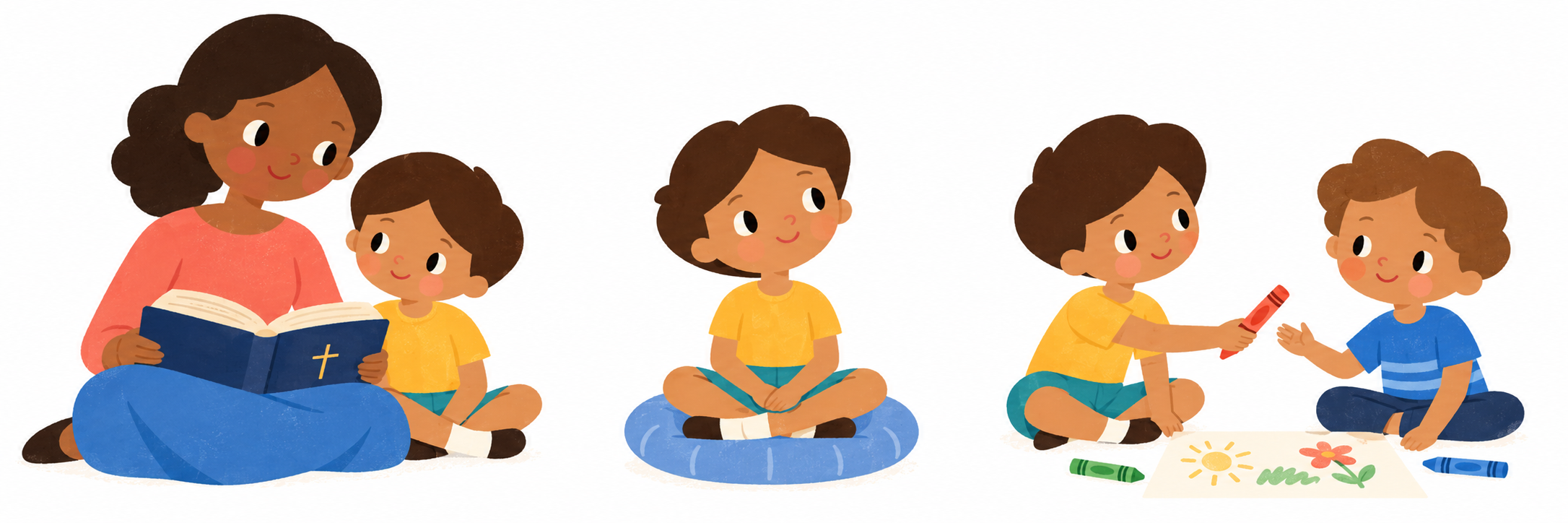
Point to the left scene. Say, “These pictures show a child today. Here the child is listening to the Bible with a grown-up.”
We hear in the Bible that God is merciful. Now look at the middle picture: the child is speaking to God. We can ask, “God, please forgive me.” God knows us; we can speak honestly to Him.
Ask “Who can we ask to forgive us and change us?”
Look and listen for “God”, or a child’s quiet attention to the picture.
If needed Supply “God” and say, “God is merciful. We can ask Him for help.”
Point to the right scene.
Here the child is sharing a crayon. We can ask God to help us love Him and other people. Sharing does not buy His forgiveness. We need His mercy and help.
Jesus is God the Son. He took the punishment for sin when He died, and He rose again. We can turn to Him and ask for forgiveness. God is merciful. We can ask Him for help.
Choose an activity and remember
Choose one option for your group; the children do not need to complete all three. Join their making or play and keep the teaching pictures nearby. Children may return to familiar play when they finish, with colouring available as a backup.
Notice and help: Listen for a child asking for help, naming God as the one who forgives, or distinguishing listening from praying in the pictures. Supply a general prayer phrase without inviting private wrongdoing. Quiet attention guides how gently you continue; it does not show whether a child has trusted Christ. Use children’s responses to guide your help without requiring everyone to answer.
Option 1 · Colour a child praying
Prepare: One colouring page (Printable Resources, page 2) and one large crayon per child, with extra colours to share. Keep the matching whole teaching picture visible.
Choose colours and make marks
Let children colour a small part or the whole picture in their own way. They may point or choose a colour while you steady the sheet.
Remember together
This is a child today, not David. Prayer is speaking to God. We can ask Him for mercy without a special posture.
With help: Offer two colours, hold the page or look at the picture together. Finishing is optional. For more: Ask, “Do we buy God’s forgiveness by sharing?” Help with “No. Forgiveness is His gift. We ask Him to help us love others.”
Give a short warning, help return crayons and put the pages in the work tray.
Option 2 · A prayer for mercy
Prepare: For each child: one prayer-card page or plain A4 sheet, one large crayon and two broad coloured-paper pieces. For each table: one glue stick and a tray. An adult folds the page once on the printed line before the session; no cutting is needed.
Open the card
Let children open and close the prepared card. Read the short prayer inside: “God, please forgive me and help me to love You and others.” Explain that a card can remind us to pray; opening it does not make God forgive.
Choose and decorate
Children add colours, broad pieces or their own drawing to the blank space. Let them decide where pieces go. Offer glue help or leave pieces loose.
Hear a prayer
Sit alongside and ask if the child would like you to read the prayer again. They may listen, point to the prayer picture or join a word. Explain that God forgives because of Jesus, not because our card is beautiful.
With help: Hold the card open while a child chooses one colour or one piece. A child may prefer the whole prayer picture. For more: Offer to write a child’s general request for God’s help. No list of personal sins is needed.
Put crayons and spare paper in the tray. An adult collects glue, clears small scraps and helps close dry cards for collection.
Option 3 · Help the toys care for one another
Prepare: two large dolls, two broad cloth mats, two large blocks and one large empty toy cup per adult-supported group. Keep the whole prayer picture and Bible nearby. The toys are ordinary people in an invented scene; use no food or small accessories.
Choose something to do
Let children choose places for the dolls and set out the blocks and cup. One doll might want to build beside the other or need a place to sit. Invite children to choose what happens next; an adult can suggest one simple idea.
Try a helpful action
Children can offer a block, move a mat to make room or bring the cup. Join their pretend play and let them rearrange the scene or choose another way to help. Model asking, “May I join you?” without creating a quarrel or taking something from a child.
Ask for God’s help
Pause beside the sharing scene in the picture. Say, “David asked God to forgive him and change him inside. We can ask God to help us love others too. Helping does not buy His forgiveness; we need Jesus.” Offer a short real prayer if children wish to listen or join, then let them continue their chosen play.
With help: offer one doll and two possible places, or move a prop where the child points. Watching beside you is welcome. For more: invite the child to suggest another helpful action and explain whether kindness buys God’s forgiveness. Help with “No. We need His mercy and help.”
Return the toys and blocks to their basket, collect the cup and fold the mats. Keep any response to a disclosure private and follow the church’s safeguarding arrangements.
A quiet or no-print option
Sit with a child near the open Bible and say, “God is merciful. We can ask Him for forgiveness and help.” No response or posture is required. Plain folded paper replaces the printed card; an adult can write or simply speak its prayer.
Keep the last few minutes of the activity period for tidying and helping children clean their hands. Watching, pointing, choosing and speaking in a familiar language are welcome ways to participate.
Remember and pray
Read the short Bible verse from Psalm 51:10 once more. The focus words below summarise the lesson; they are not a Bible quotation.
Show the sequence and ask, “What can we ask the merciful God to do?” Accept “forgive”, “help” or a point to the middle or last scene. Supply the words warmly if needed. Invite the short phrase “Please help me”, or let the children hear it from you. Do not ask them to list sins or promise perfect behaviour.
Say, “I’m going to pray. You may listen or join me.” Children can remain comfortable, with no required gesture or closed eyes.
A simple prayer
Merciful God, we need Your forgiveness. Thank You for Jesus, who died for sins and rose again. Please forgive us and change our hearts. Help us to love You and other people. Amen.
Offer the drawings and take-home page if wanted. You might tell a collecting adult, “We heard David’s prayer and learned that we can ask God to forgive and change us.” The separate take-home PDF is in Printable Resources. Keep a quiet activity available and supervise until each child is collected through your church’s usual arrangements.
The Christian Standard Bible. Copyright © 2017 by Holman Bible Publishers. Used by permission. Christian Standard Bible®, and CSB® are federally registered trademarks of Holman Bible Publishers, all rights reserved.